

A couple of weeks ago, I took my first plunge into the 2026 receiver class. In it, I used a smattering of metrics to try and figure out what kinds of receiver prospects pan out. This led to some pretty cool takeaways, such as the fact that collegiate deep-threats better be tall if they wanna succeed in the NFL.
That last finding is what I want my work to provide: ideas that feel intuitive, that you can explain to a guy on the street. The issue, of course, is that when you get into the most predictive stuff—like machine learning-based models—the path from point A to B gets a lot murkier. Thus, a big goal of mine when developing this year’s receiver model was to make it something a layman can understand: if I tweak this aspect of a receiver’s profile, how will their outlook change?
Framing the Problem
One of the hardest things to simply convey about a predictive model is just how ‘good’ it is. Ultimately, I found an article by FantasyLife’s Dwayne McFarland to be illuminating: if you’re looking for a good measuring stick for your model, what better point of reference than a player’s draft pick?
Most prominent, public-facing receiver models use draft pick as their main input. Ergo, if you want to prove your receiver model is worth its salt, you need to beat a draft-capital-only model pretty handily.
This is, of course, far easier said than done, and this doesn’t mean we’re abandoning draft capital as an input; it’s still a huge part of the process. Rather, this just means that we are no longer doing everything in a vacuum, and have a real way to concretely judge the value add of our product.
The Model
What, then, is the model that will take us to the promised land? Which magical black box achieved all my goals? To answer this question, I dug through multiple data sources, with the bulk of my final file derived from Stathead, PFF, and Pahowdy’s ever-useful spreadsheet.
Above are the average ranks, in terms of importance, for my model’s inputs. They essentially break into three tiers (ergo the coloring). In the first group, you have Draft Pick and Breakout Age (20%), which are irreplaceable core features. (Note that draft pick is log-scaled, which is a rough proxy for the draft-chart approach used in McFarland’s Super Model.)
In the second tier, all on its own, you have collegiate PPR per game, our main stand-in for a player’s college-level production. Finally, we have Relative Athletic Score (RAS), Target Rate (TGT%), and Rushing Attempt percentage (RA%).
For these three metrics, higher is (usually) better. RAS, while imperfect, is the best catchall (publicly available, at least) athleticism metric I’ve found. RA% and TGT% are good measures for a player’s run- and pass-game involvement, respectively.
Model design
This year’s model is a blend of linear regression (specifically Ridge) and a random forest. This means that the relationships between our inputs and outputs are more straightforward than usual, with fewer wacky caveats about how a change in one metric might shift our outlook on a player.
A good example of this is Breakout Age, where we see that the later you break out, the worse your prospects are as an NFL player. Again, this isn’t a perfectly linear relationship—rather, it’s more of a steady decline—but the idea is far more intuitive than what, say, a deep neural network would give you, while still performing quite well.
Model performance
What about our model’s performance, though? Is it an improvement on last year’s version, or am I blowing smoke? Surprisingly, my previous model held up pretty well; with 2025 now in the fold, it did a good job at producing three-year outlooks for the 2023 class. Yet when we introduce the prorated 2024 class—our model uses a three-year horizon, so we have to project out a bit—it falls off, predicting career outcomes worse than draft capital would alone.
One question eagle-eyed readers might have is why I’m using the Spearman coefficient over R-squared. This is mainly because, in my opinion, the most useful objective is to get the right order of these players, partly so we can cleanly compare ourselves against NFL teams. While it’s nice to say a player will produce some amount of PPR to start his career, or that we only get PPR projections wrong by a certain amount, what matters more is that we can correctly rank these players.
In short, our main goal should be twofold: how does this player compare against past prospects, and how does he rank within his own class? By converting a player’s raw PPR projection into a percentile score (0 to 100), we make each of those tasks much easier.
The Results
We’re almost ready for my preliminary predictions for the 2026 wide receiver class. Now, you might notice that I’m using Mock Consensus Rank (MCR) as a draft-pick proxy, since the draft hasn’t happened yet. I went back and forth on this a bit, and ultimately, I decided to publish this before the draft. In my opinion, big board consensus is a good enough proxy for a player’s actual draft pick number (plus, I plan to publish an updated version of this post-draft anyway).
(Note: to see the entire table on mobile, be sure to tap the image below.)
Who, then, is our model diverging from the pack on? Just as I found a while back, there’s real grounds for skepticism regarding Carnell Tate. Simply put, his production at OSU was uninspiring. Alongside his slower 40 time—and slightly less-than-ideal size—there’s real reason for concern here, and he needs to maintain his expected top-10 pick status to be considered a high-upside guy.
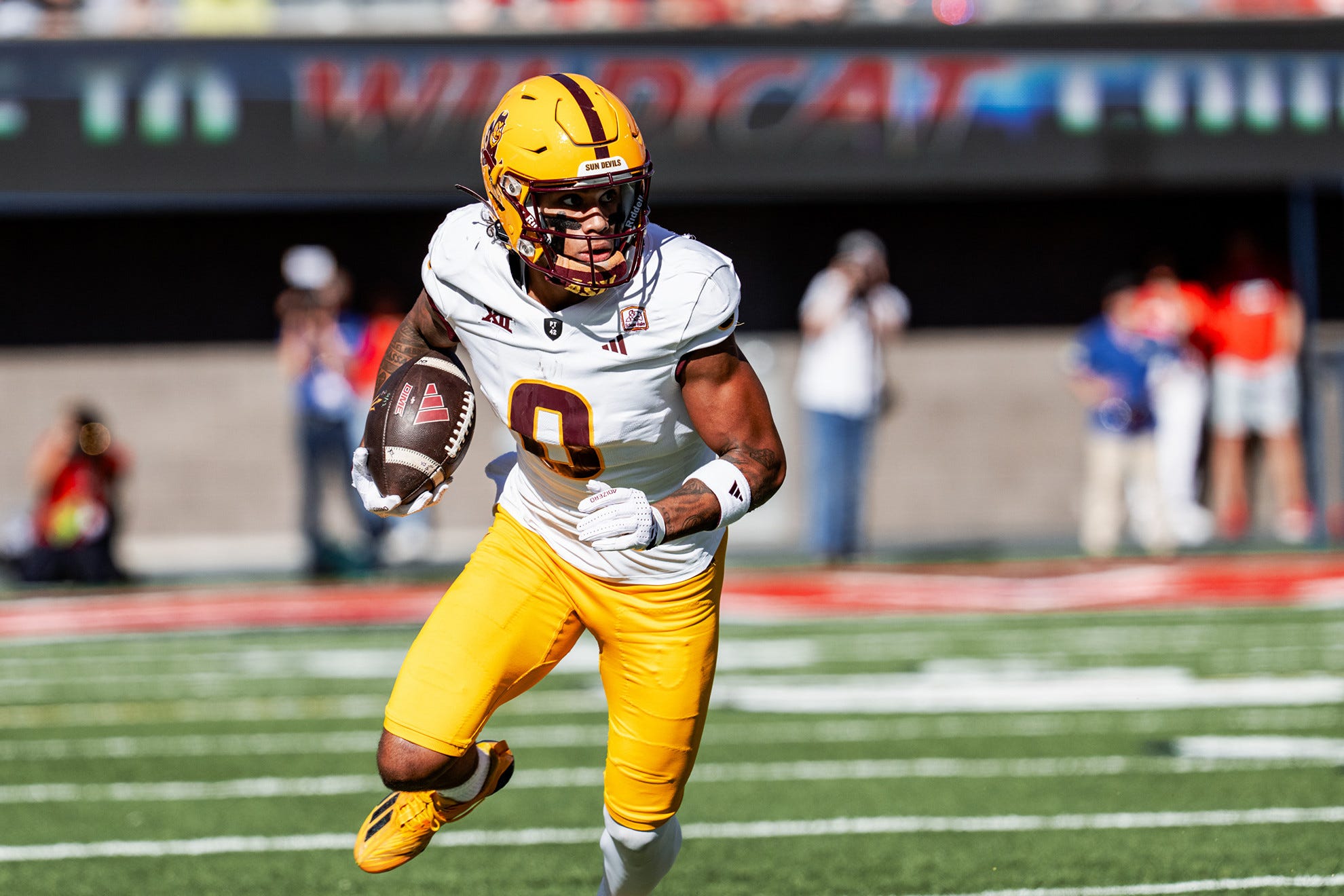
As for the crown jewel of this receiver class? That would be ASU’s Jordyn Tyson, and I think many in the industry would agree, with a few major caveats. Quite frankly, Tyson has one of the scarier injury profiles we’ve seen in recent memory.
The “low” risk Tyson is flagged with is mostly a product of his ADP, since guys who go that high usually get enough volume to be useful fantasy contributors. Yet make no mistake: the fail case is still real, and if he’s only seeing the field intermittently, it doesn’t matter if his three-year outcome clears the bar for success.
The debate between him and Tate at the top ultimately boils down to which type of risk is more worrisome for you: that the guy will never become an elite player, or that he can’t stay on the field. For a rebuilding team, or a team desperately in need of stars, I think it’s fine to take a bet on Tyson. But if you’re looking to fill your lineup with an immediate contributor, there might be a case for Tate, too.
A potential star?
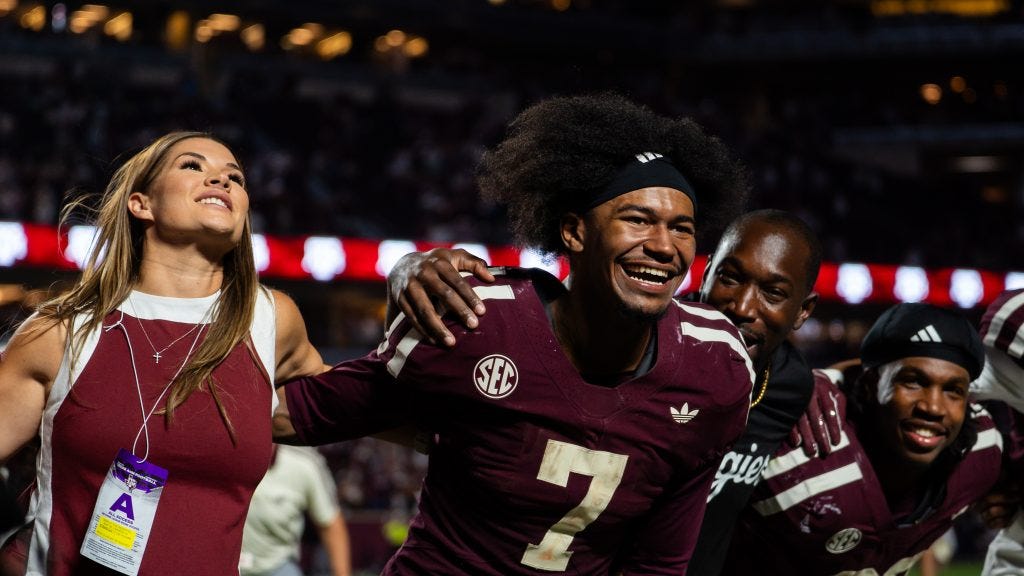
What about the rest of the class? Who are our model’s other darlings? A player who immediately pops is Texas A&M speedster KC Concepcion, who’s jumped ahead of Indiana product Omar Cooper Jr.
In fact, if we’re looking at players who our model is the high guy on, Concepcion definitely takes the cake. His recent (albeit slight) rise on the mock consensus board has elevated him to “high-upside” status (i.e., over 500 PPR projected in his first three years). This makes him a potential value pick for dynasty drafters, assuming the market doesn’t correct further in his favor
It’s useful, too, to explain why my model loves Concepcion so much. He might just be the ideal profile for the model: he broke out early, commanded a huge target share, and was a real part of his team’s run game. While none of this means I’d trade the farm for him, it’s enough for managers missing out on this year’s nominal big three to relax a bit, knowing they’re still getting a great player in Concepcion.
The fringe first-rounders
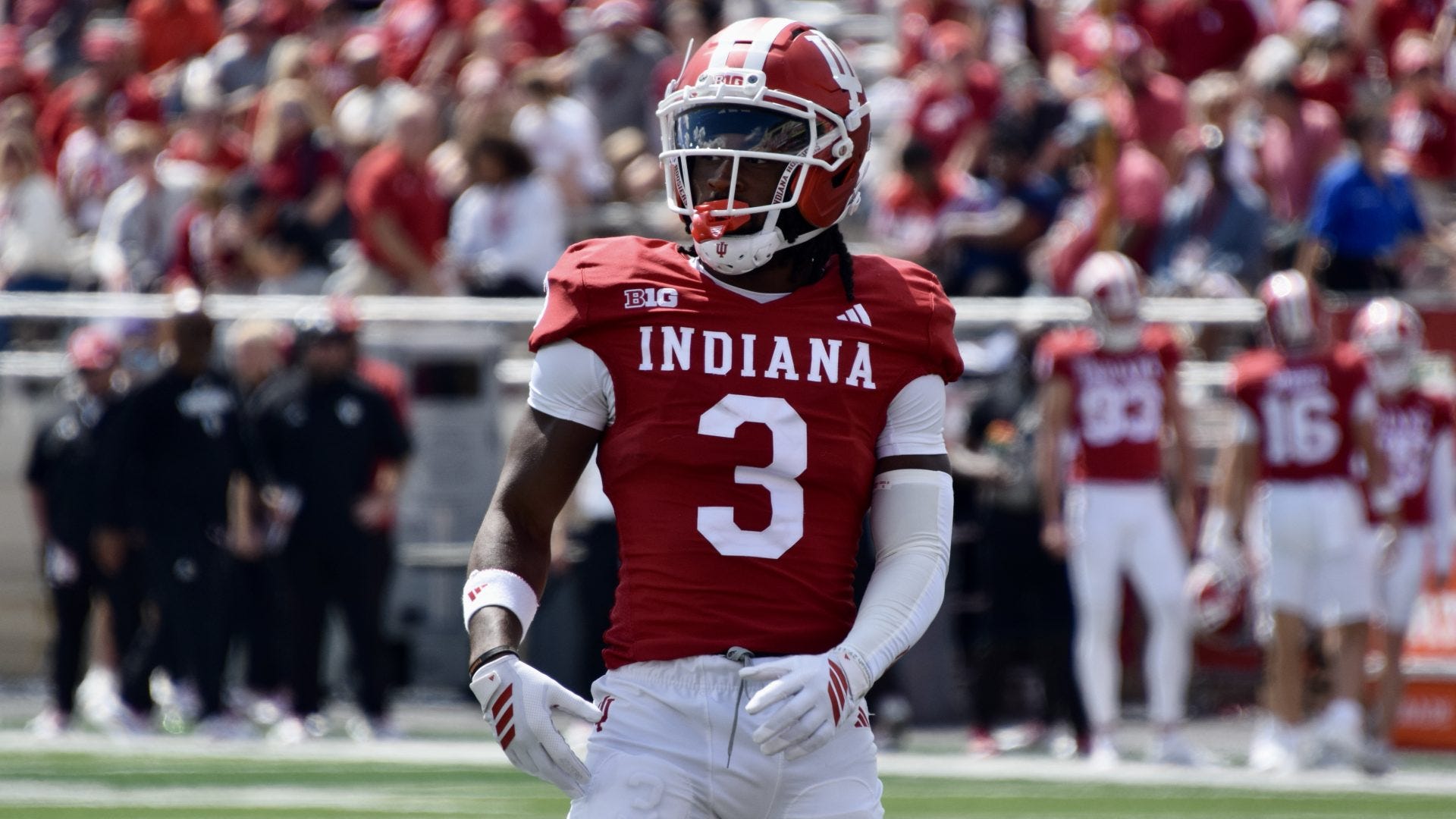
If our model likes Concepcion so much, what does it think about the other late first-round players? It’s a bit cooler on those guys, but each has their own strengths that should make us take notice.
Cooper’s nominal selling point is his athleticism, which may seem surprising for a guy who only ran a 4.47. It’s doubly confusing, too, when you realize he’s barely six feet tall and weighed in below 200 pounds. Yet there’s some burst to him—evidenced by his solid vert and 10-yard splits—even if the high-level numbers aren’t that inspiring.
By comparison, Denzel Boston was a better career producer, and broke out earlier (age 21 versus Cooper’s 22) to boot. While it doesn’t feed into our model, Boston’s big leg up (literally in this case) on Cooper is his stature. Like I noted in my previous piece, Boston clears the 6’3” bar for high-aDOT receivers, proof that he can do more than just one thing well.
Now, these guys still seem to be a half-tier below our best prospects, at least based on my metrics. A lot of their future rides on where they’re taken in the draft, with Boston in particular a decent bet to get meaningfully over-drafted. At the time of writing, they’re only considered medium-upside guys. But don’t be surprised if you check back in a month and one of these guys has shot up the rankings.
The sleeper hits

Our model is a big fan of two likely third-rounders in particular. The first is Clemson product Antonio Williams, a real jack-of-all-trades, master-of-none type as far as our key metrics are concerned. Everything about Williams is good, but not exceptional: he’s better than most players, but never quite reaches the level of our most elite prospects.
Perhaps this is best represented by his 8.8 RAS, which essentially means he’s better than 88% of all historical receiver prospects in terms of athleticism. He can run a little, broke out early, and commanded a respectable amount of his team’s targets in college. In short, he looks like the epitome of a safe bet, and playing at Clemson means these stats likely aren’t fool’s gold.
The other guy my model loves is pretty much the antithesis of Williams, i.e., a small-school baller with some truly elite traits. George State’s Ted Hurst commanded almost 25% of his team’s targets while there, and his 9.9 RAS score is hard to beat. It is fairly strange that the athletic Hurst saw little-to-no involvement in the run game, but then again, the same is true of the exceptionally athletic Bryce Lance.
Yet the one thing Hurst and Lance both have in common is they firmly clear the 6’3” bar. If you’re a traits hawk like me, and already keen on Lance, Hurst should definitely be on your radar, too. He might be a marginally better prospect, even, given his younger breakout age and actually competing at the FBS level.
Jeff Caldwell is another potential sleeper, and he unequivocally clears the 6’3” threshold by two whole inches. Yet Caldwell, like the other tall speedsters in this class, carries red flags of his own. As I covered in my earlier writeup, the commonalities between these guys—relatively low BMI, skipping the bench press—indicate they might be low-physicality fool’s gold.
Still, I reckon it’s fine take a chance swing on a guy like Caldwell near the end of your league’s draft (or even as a UDFA). Guys like Hurst are already great values at their price, and Caldwell is carried by his traits arguably even more than those previous standouts. The simple answer, is you’re not gonna find many guys out there running a 4.3 at 6’5”, let alone in the back end of drafts.
Summary
Overall, I’d say this is a pretty solid receiver class with a surprising amount of depth. For trait hawks like me, there’s a lot to like, even in the back end of the class. Maybe these guys are just track stars in disguise, sure, and maybe I’ve got too much Al Davis in me.
Still, the more time I spent with these players, the more they grew on me. A lot of them feel poised to become real players, rather than just late-round flyers, and the data agrees. In fact, the top 14 prospects all scored an 80 or above in my model (15 if you want to round up Malachi Fields’ 79).
Now, there is a pretty big cliff after those guys, so if you’re looking for fringe dart-throws to pad out your roster, this might not be the class for you. Yet I will push back on the perception that this is a weak dynasty class, even though it is, admittedly, a rough year to need a running back. And while I harp on value plenty on this blog, at the end of the day, the real name of the game is finding talent, and as far as receivers are concerned, this draft’s got loads of it.
Very intersting article, thanks for the deep-dive write-up of your model! Are your final scores in your model tiered by statistical significant differences (e.g. the drop off from Tyson/Tate/Lemon to Concepcion)?
This is such a great insightful article, thank you for sharing.