

Last week, I examined the UDFA RBs through the lens of consensus big boards. While there were some novel takeaways there, I decided to de-emphasize the big-board aspect this time around, and just focus on the receivers themselves.
There are numerous reasons for this, chiefly that there are far more dynasty-relevant UDFA WRs to cover than there are RBs. The gist is mostly the same: while there are some off-board guys who flash in year one, those with the biggest long-term impact were already on scouts’ radars entering the draft.
Ergo, while there will certainly be some camp risers and late breakouts, these known quantities are still the most likely to succeed. I thus want to spend the rest of this article dedicated to them, so dynasty managers can best adjust their waiver-wire strategies toward the guys they like.
2026 UDFAs
Without further ado, here are my model’s predictions for the 2026 UDFA wide receivers. You can read the original piece about the ‘26 draftees and how my model works here; in short, it predicts these guys’ three-year PPR outcomes based on a variety of factors, such as draft capital, traits (RAS), receiving prowess (PFF grade and targeted QBR), and production (best-year PPR/g, breakout age).
Above, you can see each UDFA inside the consensus top 400 (as shown in their mock consensus rank, or MCR). Each is given a score by my model that rates them in percentile terms; for example, my model thinks Eric Rivers is better than roughly 49% of receiver prospects since 2016. The “draft caliber” flag simply highlights if these guys’ scores are better than the worst receiver who actually got drafted in 2026.
Treacherous Traits
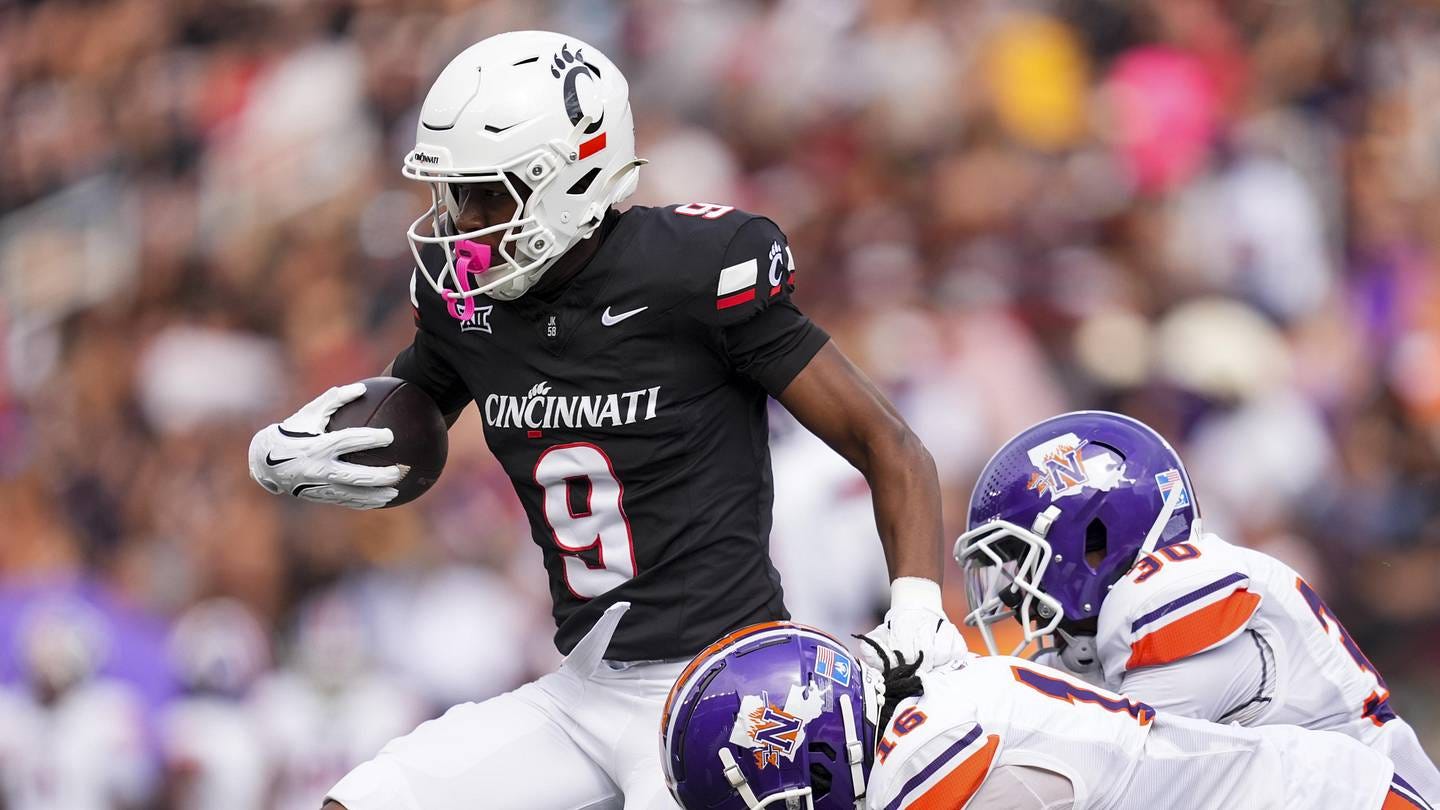
First off is a pair of tall speedsters in Jeff Caldwell and J. Michael Sturdivant. The two are notable for having near-perfect relative athletic scores (RAS), and are undeniably rare talents. Both clear the speed-size bar I previously demonstrated was necessary for high-aDOT receiver success.
It begs the question, then, why these two trait freaks would go undrafted. The biggest red flag is that, in many ways, RAS is a flawed metric, seeing Caldwell’s 216 pound weight as elite. What RAS doesn’t understand, however, is that a 6’5 guy will wear that weight a lot differently than, say, somebody who’s 6’1.
Therein lies the rub: being so slim limits the role these guys can play in today’s increasingly physical game, and The Athletic’s Dane Brugler has noted both players’ issues playing through contact. Yet that doesn’t make them lost causes; these guys either have room to bulk up (Sturdivant) or have already put in work to do so (Caldwell). Ultimately, both have traits you can’t teach, which is what you need to stand out among a crowded bunch of UDFAs.
4.6 Mafia
I might, in fact, even be understating how unique profiles like Sturdivant’s and Caldwell’s are among the UDFA crowd. Within drafted players, it’s still shades of exceptionality; most of the players taken, after all, are far better athletes than 99% of the general population.
And while this is definitely still true of the UDFA crowd—a large share of even the slowest guys were still track stars—the closer you get to the talent floor, the harder it is to hang with NFL competition. As we’ll see in the coming sections, one of the easiest cases to be made against many of these players is that they’d be true size or speed outliers if they were to succeed in the league.
Empty calories
While we spent the prior section poking holes in some tall speedsters’ profiles, one question remains: what’s the outlook for tall, skinny dudes without speed? Take, for example, new Bengals wideout Noah Thomas, a former top high-school prospect. Arif Hasan of Wide Left gives Thomas only an 8% chance of making the Bengals, which is ample proof that running a 4.6 at 6’5 and 203 lbs is a lot different than running a 4.4.
Ditto for Donovan McCulley, who, while offering real upside in a barren Dolphins receiver room, ran an impossibly slow 4.76 at his pro day. And despite the team giving him a hefty $60,000 signing bonus, his placement at the very end of our top 400 jibes with his still-minuscule chances of making the roster.
Falling down
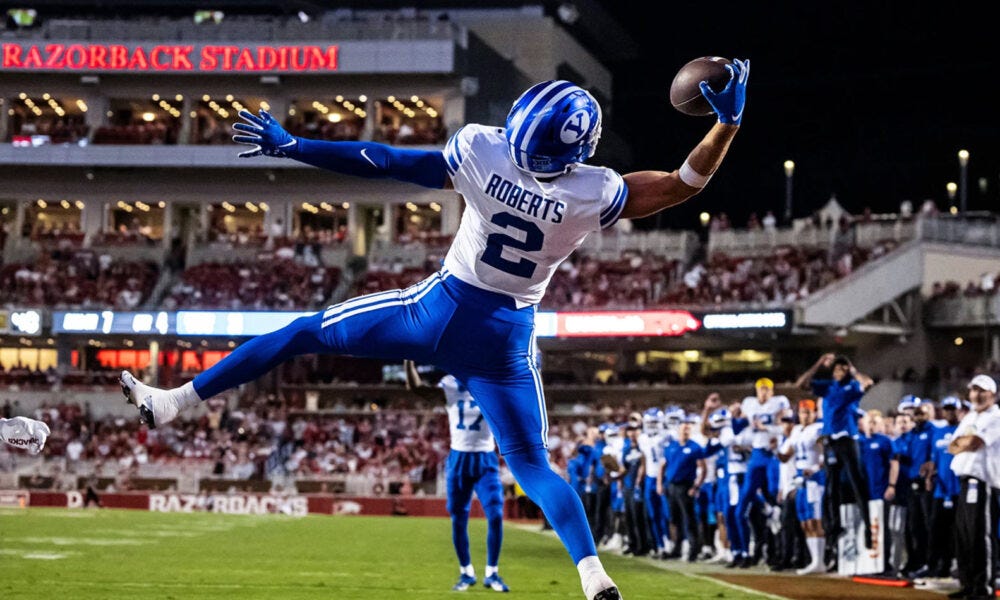
Lest I come off as more of a Negative Nancy than I already have, let’s now turn to a more interesting—and decidedly more viable—prospect. BYU standout Chase Roberts possesses the physicality that’s in question for Caldwell and Sturdivant. This is despite (or, perhaps, related to) being a card-carrying member of the 4.6 club with his 4.64 forty time.
Roberts profiles as a bit of a catch-and-fall-down X receiver, in a fashion similar to Nebraska’s Dane Key. Key is an interesting foil to Roberts, given his best production came very early on at Kentucky. Roberts, meanwhile, saw major success at the end of his collegiate career, when he was far older than the competition (a product of his LDS mission).
Though my model gives Key a slight edge, I prefer Roberts, given he’s shown some propensity to rumble after the catch. Each is, ultimately, an example of how difficult it can be to evaluate UDFAs from a production standpoint. Yet both pale in comparison to the challenge John Carroll standout Tyren Montgomery provides us.
Montgomery only started playing football at the age of 22—he was a walk-on for LSU basketball—and is, as a result, understandably raw. This places him at the opposite end of the elder-rookie spectrum from the maxed-out Roberts (somewhat ironic given he has a 1,500 yard season under his belt). While an underdeveloped 25-year-old is a hard sell, he’ll have all the chances in the world to prove it against an equally green crop of Titans youngsters.
Returner Investments
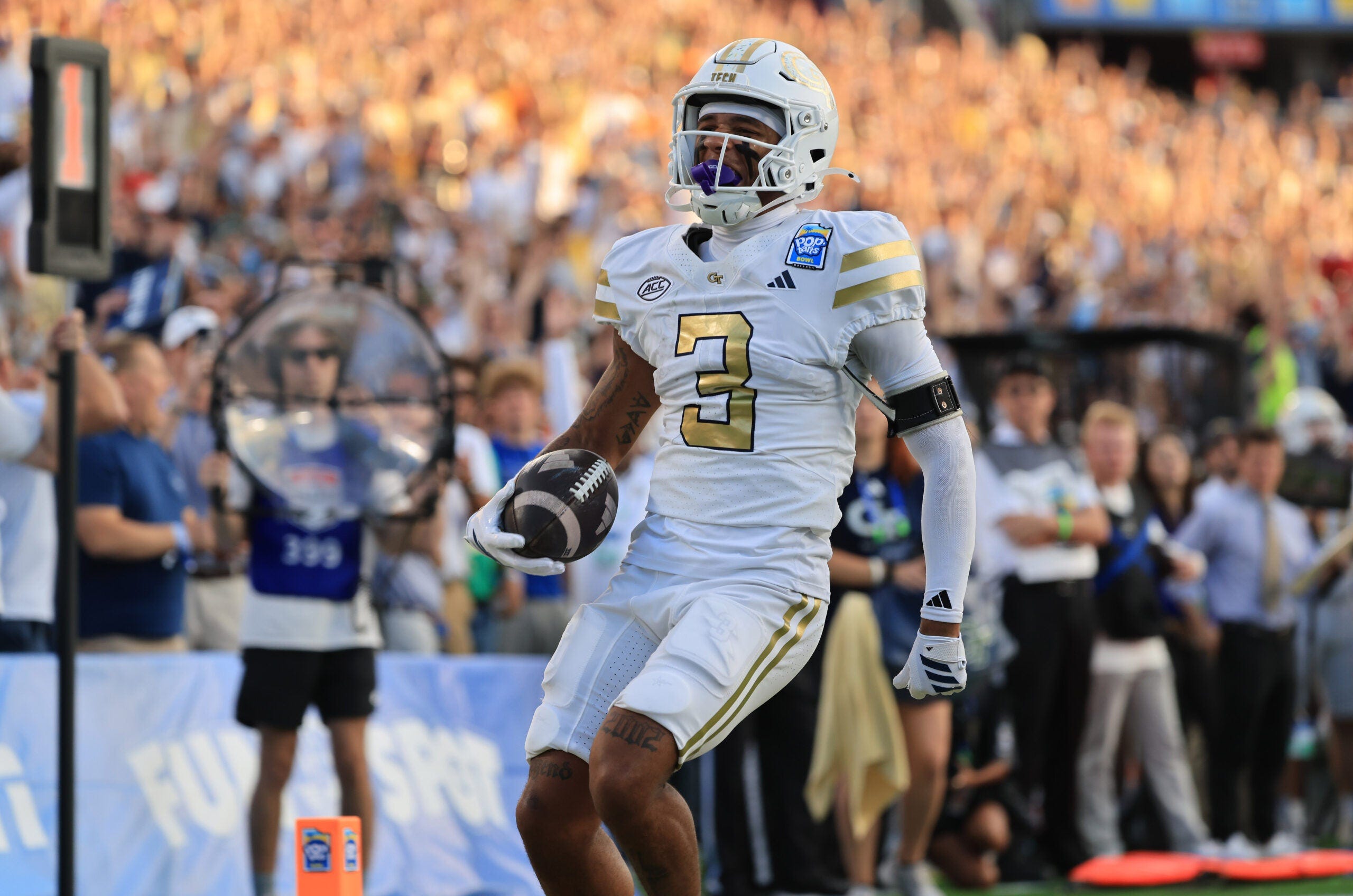
The overall point of sifting through these UDFA’s is to find potential “real” players, at least from a dynasty sense. That doesn’t mean, however, that we should limit ourselves to guys who merely look the type. Indeed, if the main hurdle is making the team, then we should look at prospects who can provide any sort of utility. This leads us, of course, to future special-teamers and, in specific, return specialists.
The first to fit this bill—and most likely earn playing time beyond just return duties—is Georgia Tech’s Eric Rivers. Rivers has real, albeit not elite, speed, and was a successful deep target at Georgia Tech. He was arguably even better at his previous stop at Florida International, where he racked up over a thousand yards and 12 touchdowns.
The caveat, of course, is that Rivers is pretty undersized. While you could argue the clip above is a bit of an underthrow from Haynes King, it gives you a good picture of both Rivers’ strengths and limitations. All in all, Rivers’ chances of NFL success will be defined by his already small margin for error growing even narrower against unforgiving NFL competition.
Of the remaining guys with returner profiles, two of them offer real promise, though to a lesser extent than Rivers. Vinny Anthony had the great misfortune of playing in a woebegone Wisconsin offense, with some suggesting he was poorly utilized as an outside player, given his small size and second-best-in-class three-cone. Those pundits likely have a point, and given the state of the Falcons’ receiver room, he should be given no shortage of chances.
A guy with perhaps even more juice is Caullin Lacy. He ticks some of the right boxes for my model; namely, he has a good best season (over 1,300 yards at South Alabama), and got enough carries to suggest a potential gadget role. While he fell off a bit after transferring to Louisville, there’s enough multi-dimensionality to his game that he could contribute on offense, and not just special teams.
I can’t say the same, however, for a different sixth-year transfer, Trebor Pena. His entire profile rides upon one year at Syracuse, albeit a solid one where he came very close to racking up a thousand yards. Pena also has serious returner bona fides, which were no doubt a big reason Penn State gave him serious NIL money to transfer. Yet given the paltry performance outside of the one big year, as well as his underwhelming size, I think he’ll offer far less dynasty value than he might as a returner.
Tigers & Mustangs
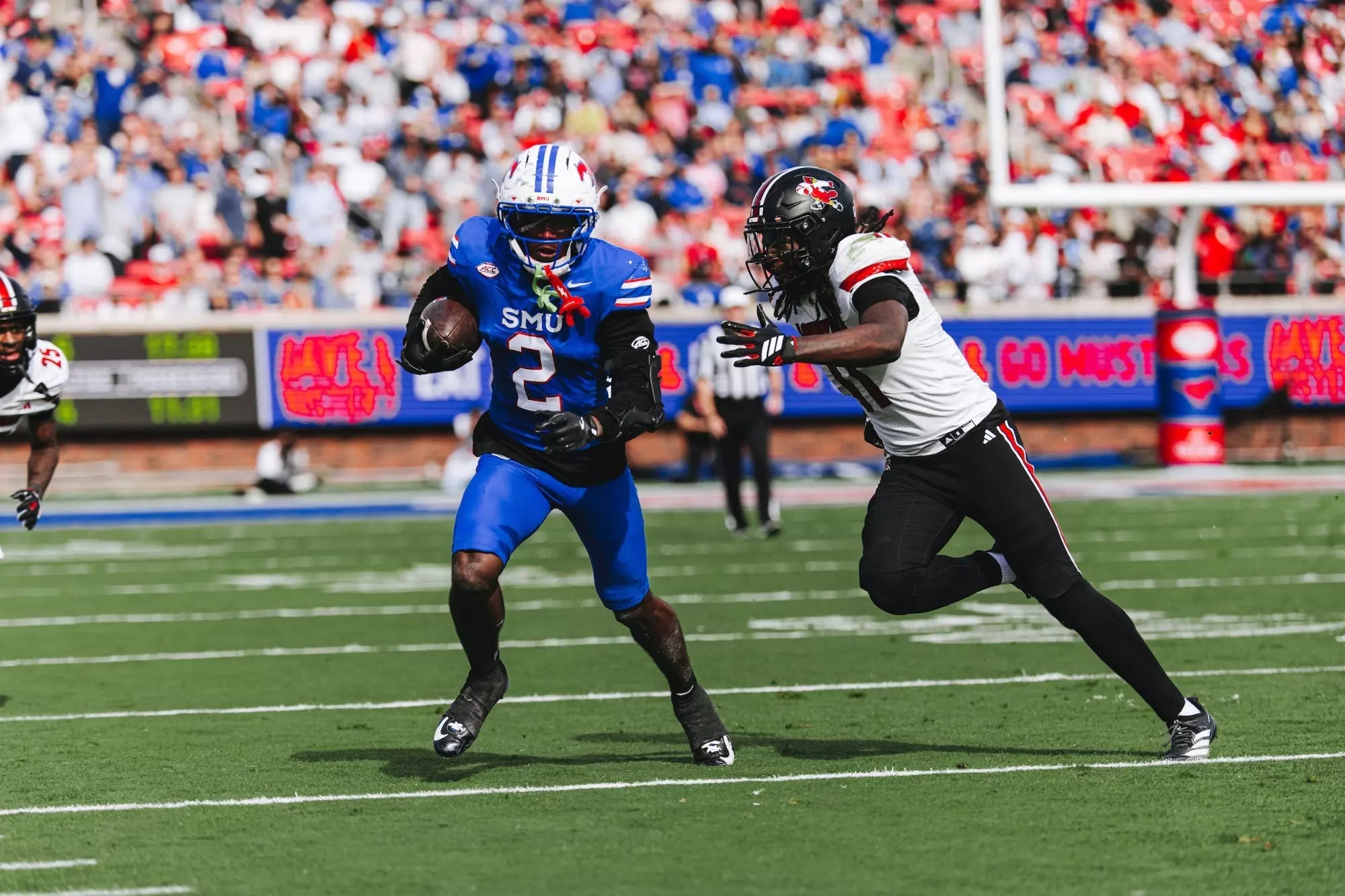
Closing things out, we have two duos who share alma maters. First are some slow SMU Mustangs, who are more of a piece with our 4.6 forty group than anything you’d see at the racetrack. The first of these is Romello Brinson, who warrants little attention due to being a one-trick pony. Given his deep-threat abilities are his calling card, at that speed, I’m not terribly interested.
More compelling is Cowboys signee Jordan Hudson, who has a real chance to break through. While sources quibble about whether he’s a boundary X or merely a Z/power slot type, he’s shown real YAC ability despite his lack of speed. He feels like the type who will pop up on dynasty radars later into the offseason if he manages to crack the roster.
As for the other same-school dyad, these guys carry a far greater pedigree, given the well-earned reputation LSU bestows upon its receivers. Indeed, many college football casuals may wonder why they haven’t heard much about Aaron Anderson and Chris Hilton, given how many excellent Tigers have made their way into the league over the years.
Even those who do follow the sport, however, may be somewhat puzzled about what exactly happened to Hilton and Anderson, given their status as former top-50 high school recruits. In Hilton’s case, it’s as simple as injuries, which limited him to no more than 250 yards in each of his collegiate seasons. Ironically, I’d still rate him as the better of the two prospects, given his height clears six feet and he ran a 4.4.
Anderson, meanwhile, is far more uninspiring, despite posting nearly 900 yards in 2024. At 5’8”, he doesn’t show the requisite speed to stand out as a slot, and his short arms (plus a brutal 1.25 RAS score) would be the final nails in the coffin for his already slim NFL prospects.
Summary
It’s ironic that in a draft class so deep in receiving talent—and bereft of good RBs—I still see the undrafted running backs as having more dynasty potential. A lot of this is simple math, since there’s a far broader range of outcomes that managers will accept from running backs. Both spot and long-term RB starters offer real value for managers; third- or fourth-option receivers likely won’t.
I’m probably underselling the upside case for receivers, of course. It’s not just undrafted running backs who can unseat higher-pedigree players, as the likes of Jalen Coker have shown us. If we are to believe the narrative that there might never be a bad receiver class again, then it should also hold that the guys at the bottom of the roster are also upping their game.
Do I actually buy into that narrative? In part, but I also think this piece has shown us that even if receiving ability has improved over time, there are only so many players in the world with elite receiving talent. What I can be sure of, however, is what a good receiver looks like in mathematical terms, with my model bridging both the stats- and trait-based cases for my receivers.
And while it’s hard to find a guy who excels in both among the UDFAs, at the very least, I think we’ve found some useful players. It wouldn’t surprise me, really, if a few of them pop up on broadcasts in the ‘26 season.