

In the past couple of weeks, I released my updated running back and receiver models. The issue with both was, however, that I needed to use a substitute for my most important input—draft capital—since the draft hadn’t happened yet. Now that we have the data, we can finally see its impact on my model’s projections.
RB’s dire turn
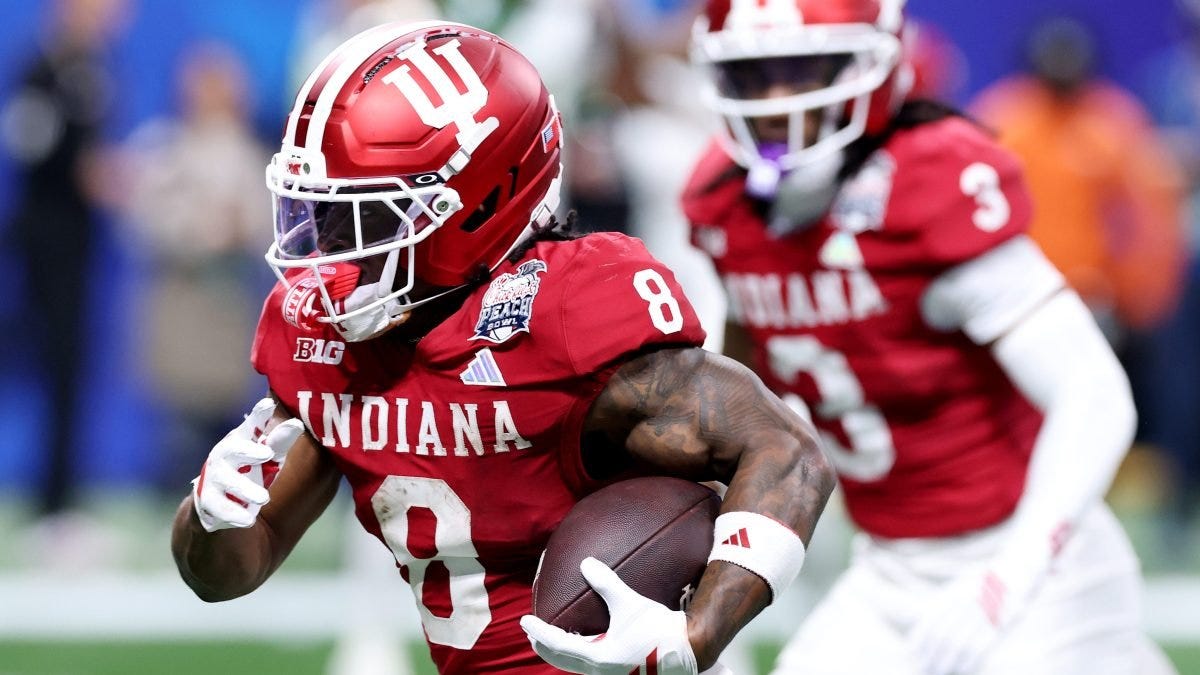
While I generally touted the bull case for running back going into this draft, it’s hard to argue the event was anything but a miserable stroke of luck for the RB’s. This isn’t to say, of course, that things were worse than my data suggested going into the draft, but at least from a quantitative angle, things didn’t get much better.
Oddly enough, though, I think the outcome of the draft was sneaky good from a qualitative perspective. To be sure, there are echoes of the 2024 RB class—which already looks quite poor—in the sense that most guys you’re drafting are more upside handcuffs than immediate starters. Yet I’d argue that the landing spots are largely good for each back taken this year, from both floor and upside perspectives.
Mid-round winners
Jonah Coleman and Emmett Johnson, for example, both landed in situations where they won’t be asked to be the top dog right away, but they also complement their backfield mates quite well. In Coleman’s case, while I still like RJ Harvey from a PPR standpoint, it seems the Broncos don’t want to use him as a pure bellcow, and I’m sure Sean Payton would relish the chance to grind out games on the ground (if only to take pressure off Bo Nix).
Johnson, meanwhile, might be my model’s most savvy tout in the middle rounds. His great PFF grades and decent receiving upside give him the rare distinction of the being dubbed a high-upside mid-rounder by the model, putting him in the company of some truly excellent receiving backs. And given Kenneth Walker’s injury history, betting on Johnson is hardly wishful thinking.
Another interesting riser (despite the data giving him roughly the same score as before) is new Tennessee back Nicholas Singleton. While I don’t think you should get over your skis with Singleton just yet, Tony Pollard is getting older (and almost a free agent), and Tyjae Spears hasn’t really proven much in his time in the league. Ergo, if you’re buying Tennessee’s offensive improvement—which, given their decent O-line, you probably should—Singleton could be another great opportunity-based value.
Hidden gems
Lastly, we have two late-round players who I pegged going into the draft as potentially worthwhile dart throws, with each being flagged as ‘medium’ upside despite their late-round status. Kentucky’s Seth McGowan was an excellent tester at the combine, and while the Colts backfield is definitely crowded now, Jonathan Taylor is closer to free agency than you might think. There’s a similar upside case for new Vikings back Demond Claiborne, who, while meaningfully undersized, has a case for being a viable Aaron Jones replacement if you squint hard enough, at least from a receiving angle.
Better WR clarity
While the RB class involved a lot of hedging, I’m prepared to speak more forcefully about the best WR’s in this class. By being taken in the top 10, for example, Carnell Tate and Jordyn Tyson were firmly enshrined as top-flight receiver prospects (my model gives them elite three-year upside). Just below those two, KC Concepcion—who our model was bullish on going into the draft—now joins Makai Lemon in the high-upside (albeit not quite elite) tier.
Perhaps more notably, Omar Cooper and Denzel Boston fell down a tier, joining surprise riser De’Zhaun Stribling to round out a cadre of, per our model, medium-upside, medium-floor guys. Keep in mind, of course, that these three players are still meaningfully superior to the medium-upside, high-risk guys below them.
Before we get to that throng of similarly rated players, however, an odd little tier 2.5 of medium-risk (and upside) guys exists. (Note: to see the full list of prospects, be sure to paginate right in the table above.) This tier is comprised of Germie Bernard (Bama) and Antonio Williams (Clemson).
Beyond shooting up the draft board, Bernard was also a big beneficiary of some post-draft model tweaks I performed. Since so many prospects were being harmed by early-career throwaway seasons, I decided to use best-year, per-game (collegiate) PPR scoring. This meant that Bernard, who couldn’t see the field at Michigan State, got a boost for his Alabama playing time, and like many of the other guys in this tier, found an excellent landing spot with Pittsburgh.
Williams, by comparison, was already flagged by my model as a stud, and even post-draft, he continues to outpace other players taken in his range. As I noted pre-draft, he’s a bit of a jack-of-all-trades, master-of-none type, and also found a great landing spot in Washington. Despite the Brandon Aiyuk rumors, it’s hard to think of a better talent and opportunity fit outside the first round.
The rat’s nest
For as clear as the top of this class was, however, the middle tier of this receiving class is an absolute mess. While I think managers far too often fall into the trap of playing the landing-spot game, that’s only folly when you’re drastically ignoring draft capital. That isn’t the case here: this echelon of receivers is so closely bunched together that I actually think some subjective judgment is warranted.
Before doing that, though, we can at least take some layups. Two of these guys—Zavion Thomas (Bears) and Caleb Douglas (Dolphins)—are regular Vincent Adultmen, whose rise up the board far exceeded their actual stature. While my model likes Douglas fine, I’ll point to the excellent work Arif Hasan and others have done on draft-day reaches, which suggests severe deviation from big boards rarely pays off.
Another guy in this tier echoes the iconic BoJack Horseman character in a different way, in that the way he moves at his height is just too good to be true. While writing a prior piece, I started to realize how skinny speedesters are increasingly fooling RAS with their ridiculous height-speed combos. This of course brings us to Tennessee product Chris Brazzell, whose gimmick-offense background already gave us enough grounds for skepticism; that he’s also sub-200 lbs at 6’4” is pretty scary.
To be sure, RAS is still a useful part of my model, and including some measurement of athleticism is likely better than not. But it’s worrisome how speed threats are increasingly able to game the RAS system, while equally athletic big-bodied types—like new Giants WR Malachi Fields—are unduly punished for their slowness.
To this point, I should also touch upon Georgia State’s Ted Hurst and UConn’s Skyler Bell. In my pre-draft writeup, I touted each’s high target share, but forgot that stat has diminishing returns, to the point where super-high volume is actually a negative for our model. It’s a good safeguard my model has against Jalen Royals syndrome, but the fact that these slimmer speedsters don’t see much RAS penalty just shows how flawed a metric it can be at the extremes.
Ravens’ pecking order
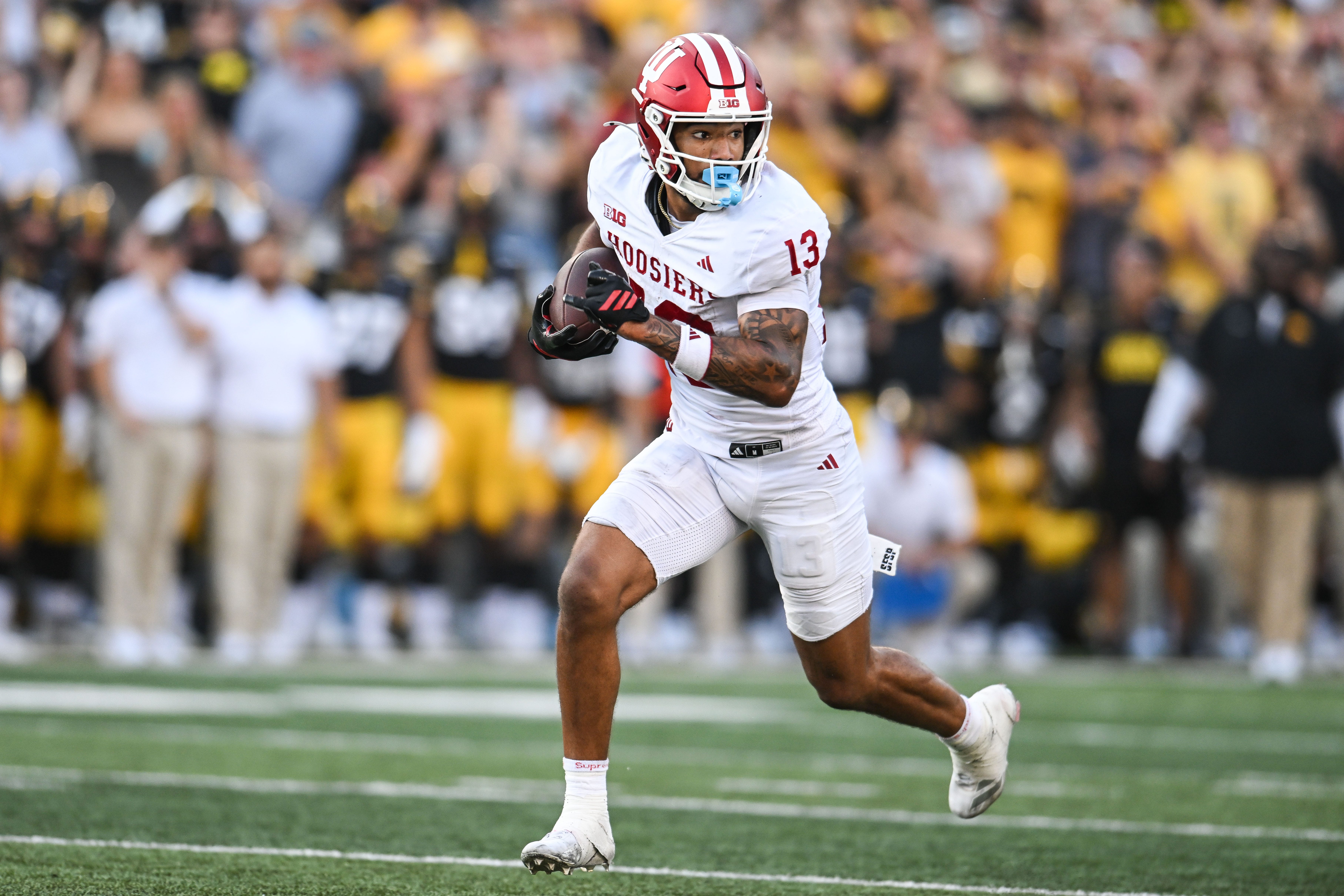
Another big faller is Indiana’s Elijah Sarratt, but his case is a bit more muddied. Sarratt and his new teammate Ja’Kobi Lane make for a fascinating juxtaposition, given their reversal of fortune from where they stood pre-draft. At first blush, it looks like Lane has a clear edge up on Sarratt, going about a full round earlier with nominally better athleticism.
Yet this may be yet another case of RAS trickery, since while that metric favors Lane, build might be the biggest factor in Sarratt’s favor. Simply put, Lane is a bit light-in-the-pants, and his addition surely frustrated analysts tired of the Ravens’ penchant for lighter guys with questionable play strength. Sarratt, conversely, likely pleased those same detractors; even if he ends up as a power-slot type, he’s still a bigger body than the team has seen in a long while (the withered husk of Nuk Hopkins excepted).
Sarratt was widely rated as a meaningfully better prospect (by consensus big boards) than Lane, too. He also matched—if not outproduced—Lane on every metric our model uses beside RAS, which almost begs the question of why, exactly, any fantasy manager would pick Lane over Sarratt. The blunt truth is, draft capital often tells you how a team ranks guys relative to each other, but I’m also not one to argue with The Athletic’s Dane Brugler, who ranked Lane (25th) far below Sarratt (12th).
Late-round bonks
I’m sure many of my readers listen to the Ringer Fantasy Football Show. While this reference is certainly dated by now, it’s time to talk about a couple of guys my model would flag as “go home to your wife” traps. The first of these is Bryce Lance, who I had high hopes for going into the process. Ultimately, he’s sunk by his late breakout age; while this is a bit unfair to him (I’ve heard NDSU likes to sit guys), it’s ultimately a good counterbalance for his FCS-prospect status.
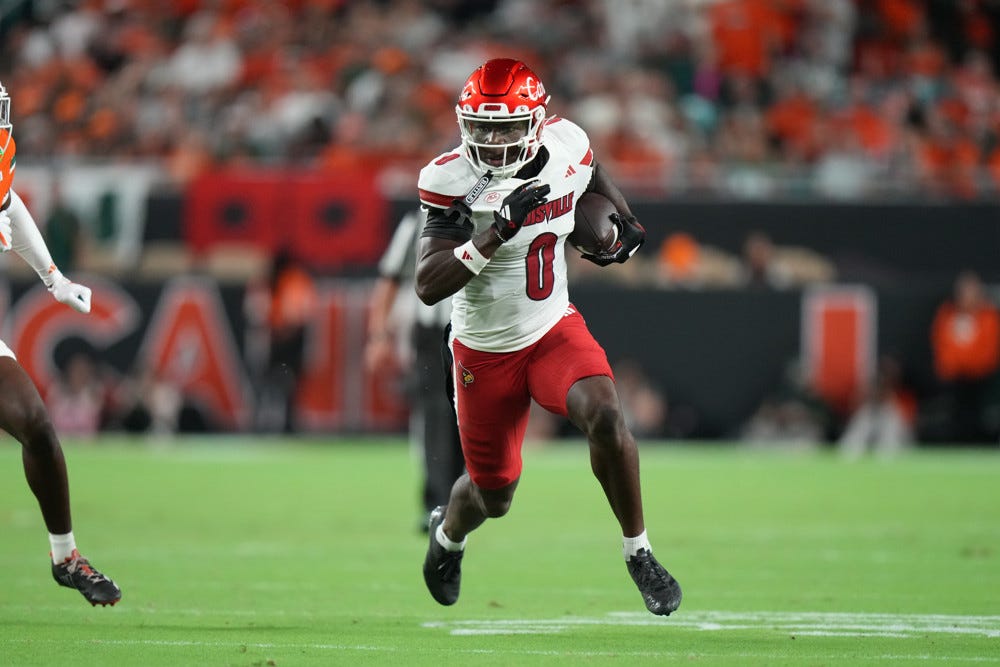
The last player I think bears addressing is Louisville product Chris Bell, perhaps the hardest prospect to rank in this class. Wherever he goes in your league, though, I can pretty firmly say I disagree with managers taking him as early as the late first. Given that was his pre-draft range, that means people think his nominally excellent landing spot (Miami) totally offsets his precipitous fall, which I can’t quite get on board with.
To be sure, I don’t doubt Bell’s talent, nor will I pound the table for any other guys in his real-life draft range over him. Yet the math isn’t in his favor: just as Hasan’s analysis earlier found reaches were fool’s gold, nominal “steals” like Bell are only marginally better than at-value picks. The blunt truth of the matter is that NFL teams have extensive medical and character info the public can only dream of, and if Bell’s injury history caused him to fall to the middle of the third round, then there’s real cause for concern here.
And while I won’t cape super hard for, say, Germie Bernard or De’Zhaun Stribling, the math of second-round picks like them and Williams making it is a lot better than Bell’s case. If the data-based case for Bell were a bit stronger, then I’d tolerate the dart-throw, but he’s meaningfully dinged for his later breakout age and combine no-show because, well, he was hurt. Ultimately, injury history is a signal, and it’s one of the many things draft capital (among other metrics) implicitly captures, so ignoring it in favor of other upside indicators is, in my mind, a tad foolish.
Parting thoughts
Ultimately, while the specifics of how the draft fell were a bit different than I expected, a lot of my pre-draft prognostications proved pretty prescient. While I was directionally wrong on how RBs would move on the board post-draft, outside of Mike Washington, I don’t think any of the landing spots were catastrophic. As an RB-needy owner with only a handful of second- and third-rounders to work with in one league, it’s about as good as the board could’ve fallen for me.
And maybe it’s the knock-on effect from the RBs falling down the board, but the way most Dynasty mocks have fallen post-draft, it seems the community agrees on this being a deep receiver class. Just like with the RBs, the guys outside of the first round may not get an immediate crack at heavy volume, but you don’t have to squint very hard to see opportunity in a lot of their cases. And while this might be blind optimism, I don’t think this year will be a repeat of the Kyle Williams or Jalen Royals situations some have feared; even if 2026 was a weaker draft class, many of these WR’s saw a bigger draft capital investment than a fringe fourth rounder like Royals.
But that’s all for today. I’ll be back next week with a write up on this year’s tight ends, a group which is, hopefully, just as deep as the receiving class was. Join me then, and hopefully I’ll be able to get through them more concisely, because as much as I like these receivers, they gave me a lot to unpack.
Good stuff, Chris, damn good stuff. Appreciate the write-up!